 Utku Kaynar
The Pitch, Decoded
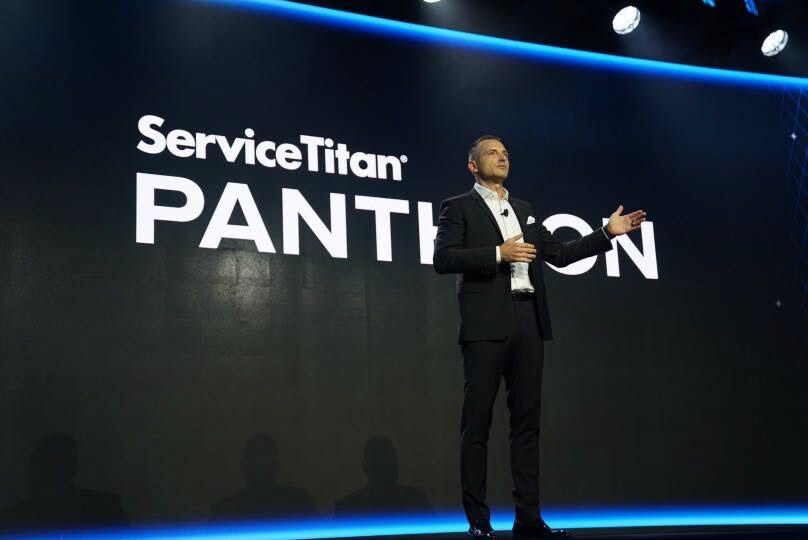
Photo © ServiceTitan. Courtesy of ServiceTitan.
Part one of eight in a short series: Pantheon 2026: A Strategical Analysis.
ServiceTitan held Pantheon, its annual customer conference, and spent three keynotes telling the trades what comes next.
I read the transcripts of the main sessions. They're auto-generated and noisy. "Alice" is Atlas. "Pandion" is Pantheon. The press coverage will tell you what was announced.
I want to ask a different question of every claim: what has to be true for this to work, and who does it actually serve?
Claim one: thirty agents need one brain
Ara Mahdessian, the CEO, built the conference on a five-level AI maturity model. Ask AI. Automate a workflow. Automate many. Coordinate them. Let the system learn.
Level four is the argument. Independent agents, he said, make locally right and globally wrong decisions. The ads agent spends while the board is full. The voice agent books a big job and dispatch sends a junior tech.
The examples are real. Now look at what the argument does.
AI collapsed the cost of building point solutions. Any single agent can be cloned in a weekend. For a suite whose pitch was "we do everything well enough," that's an existential threat.
So the moat moved. Not features. Coordination. You can buy a better voice agent anywhere. You supposedly can't coordinate thirty agents without one system of record. And ServiceTitan is the system of record.
"Independent agents fail" is a product insight and a moat argument at the same time. Notice who benefits from the conclusion that you shouldn't mix vendors.
Claim two: profit doubles
The product is Max. Thirty agents, every Pro product, a dedicated specialist. Fifty pioneer shops today, 700 locations targeted by fiscal year-end.
The pitch was arithmetic. Improve leads, booking rate and average ticket by 10% each. Revenue rises 33%. Profit doubles, because costs don't have to rise with it.
That math is true for one company. Hold that thought; it's the subject of the next post.
The 700 isn't about unit count. It's revenue per location. Max is a machine for raising what each customer pays.
Abhi, the CTPO, supplied the Wall Street version. The room collects about 60% of the revenue it could. The best shops reach the high 80s. Call it half a million dollars per million, "to go get."
Translate that. ServiceTitan's next growth engine is the wallets of customers it already has. No new logos required.
Claim three: Atlas is your chief of staff
Vahe Kuzoyan, the President, turned Atlas into a chief of staff. It writes its own reports, does research, monitors KPIs, reconciles ad spend to the general ledger. It will replace the office app and every outbound notification.
Next year: read your email and calendar, attend your meetings, build agents in plain English.
Two things are true about that list.
First, it's a quiet admission. If the main interface becomes a conversation, fifteen years of screens stop being the moat. I've argued that the interface is free now. ServiceTitan just agreed on stage.
Second, everything on next year's list is what general-purpose agents from the frontier labs already do, with broader context and a faster model cadence. More on that in part five.
Claim four: Homh wins the agent era
The boldest swing was Homh: a contractor marketplace built for consumers' AI agents. It's live as a plugin on the three major AI platforms. Contractors are ranked on punctuality, hire rate and job quality. No pay-to-rank. Invite-only in key markets.
ServiceTitan has always lived downstream of demand. Google, Angi, Thumbtack and Yelp sent the customer; ServiceTitan ran the job. Homh is a bid to own the front door.
It's the most ambitious idea of the conference. It's also built on someone else's platform, ranks only ServiceTitan's own customers, and grades the people who pay the bills. Part six.
Claim five: it's already real
Abhi's demo was the proof. Lead scores as probability ranges. Ad spend tied to open capacity. A financing prescreen on every booked job. In-home recording feeding good/better/best options and live sales coaching. An agent that finds unbilled work.
The headline result: Max and Pro customers grow revenue about twice as fast as their peers.
Look at the evidence, though. Testimonials. A demo. A growth claim drawn from pioneers who were already the best-run shops in the room. That's selection bias, not proof.
And Abhi's first priority wasn't agents. It was reliability and uptime. You don't open with the thing that's going well.
What's actually real
Strip all five claims down and one asset is left standing.
Jobs, customers, equipment, invoices, payments, technician history. ServiceTitan owns the ledger of the trades, and the payments revenue that flows through it.
That's not AI. It's the business.
The agents are the story. The ledger is the business. The rest of this series is about why the story and the business pull in different directions.